Adaptive Fashion Education Initiative
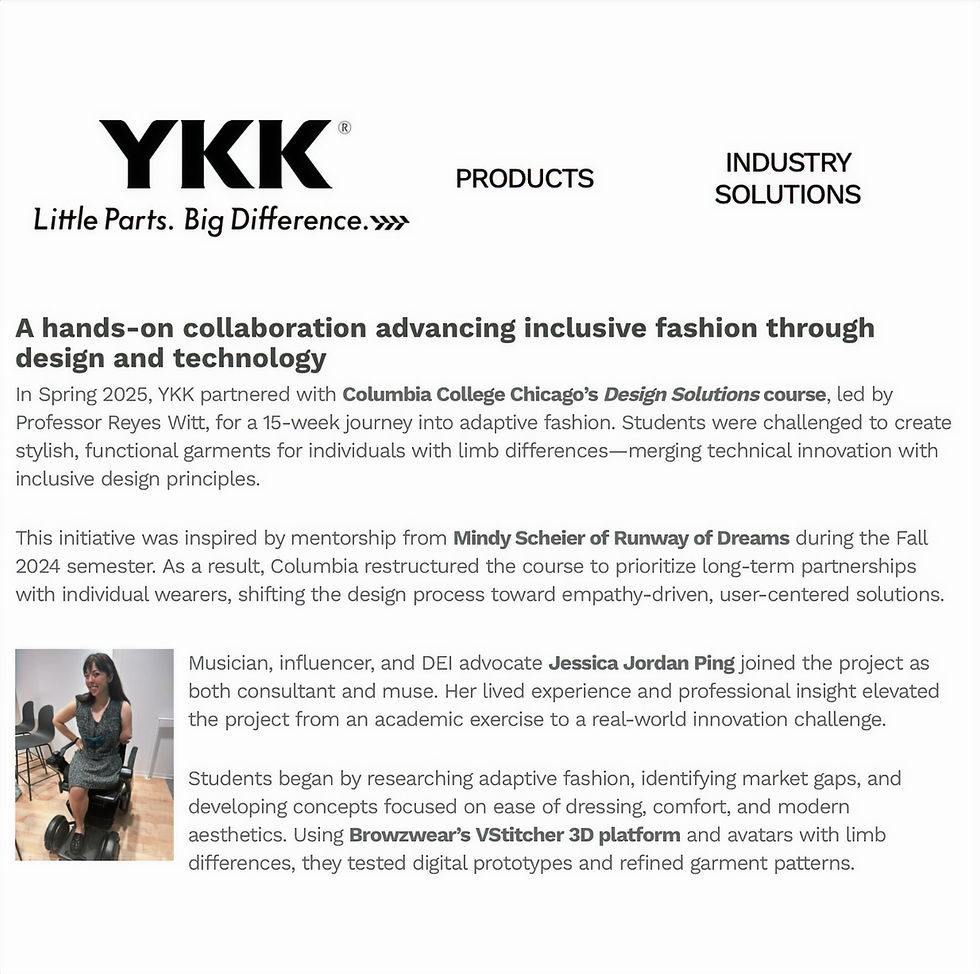
At Columbia College Chicago, I designed and launched the first higher education course dedicated to adaptive fashion. Partnering with YKK, Joe & Bella, Silvert’s, Runway of Dreams, and disability advocate Jessica Jordan Ping, this course empowers students to research, design, and engineer garments that respond to the needs of individuals with physical barriers while reframing adaptive design as a universal practice rather than a niche specialty.
Human Centered Design Approach
By merging empathy, engineering, and aesthetic design, this initiative builds a bridge between fashion education and social responsibility. The goal is not to design for people with disabilities, but to design with them, normalizing adaptive features and expanding what inclusive fashion can mean across categories.

Human-Centered Design Framework
Built curriculum grounded in human-centered and universal design principles that emphasize empathy, inclusion, and functional beauty. Students learn to identify user pain points and design solutions that restore independence, comfort, and confidence.

Research-Driven Ideation
Built curriculum grounded in human-centered and universal design principles that emphasize empathy, inclusion, and functional beauty. Students learn to identify user pain points and design solutions that restore independence, comfort, and confidence.

Product Engineering & Critical Anaylisis
Encouraged students to think critically about how clothing is engineered for individuals with physical barriers. Projects examined closures, adjustability, and sensory comfort, teaching students to merge design integrity with usability.

Intergrating 3D Design & Technology
-
Introduced 3D visualization and prototyping early in the process to test accessibility features, fit, and functionality. Students applied digital tools to refine patterns and accelerate iteration cycles, blending technology with empathy.

Collaborative Industry Partnerships
Connected students with adaptive apparel brands, advocates, and manufacturers, offering real-world collaboration opportunities. These partnerships provided mentorship, professional feedback, and tangible insights into the future of inclusive design.
Normalizing Inclusion
Instilled a design philosophy that positions adaptive features as integrated elements of good design, not specialized add-ons.
The course promotes universal thinking that broadens audience reach and normalizes inclusion across all apparel categories.
Results
• Students are organically integrating universal design principles into projects across the broader Product Development curriculum, demonstrating lasting impact beyond the adaptive fashion course.
• Established long-term partnerships with YKK and other adaptive apparel leaders, bringing professional mentorship into the classroom.